
“It will always be this way.”
“Nothing works for depression.”
“I’ve already tried everything.”
“I can’t deal with this.”
“No one can help me.”
Most people who suffer from chronic depression have had thoughts like these. Many of us have them regularly. With Persistent Depressive Disorder (PDD), hopelessness isn’t a rare, situation-based feeling; it’s a low-level constant background noise.
The thing is, these thoughts just aren’t true.
No, depression isn’t curable. But it is treatable. In fact, it’s one of the most treatable mental health conditions. Study after study confirms the value of a wide variety of cognitive, emotional, vocational, behavioral and relationship strategies for depression treatment, and most of them are widely available.
Of course, that doesn’t mean these treatments are easy. Nothing about depression is easy. It just means that even on your worst days, there’s probably something you can do.
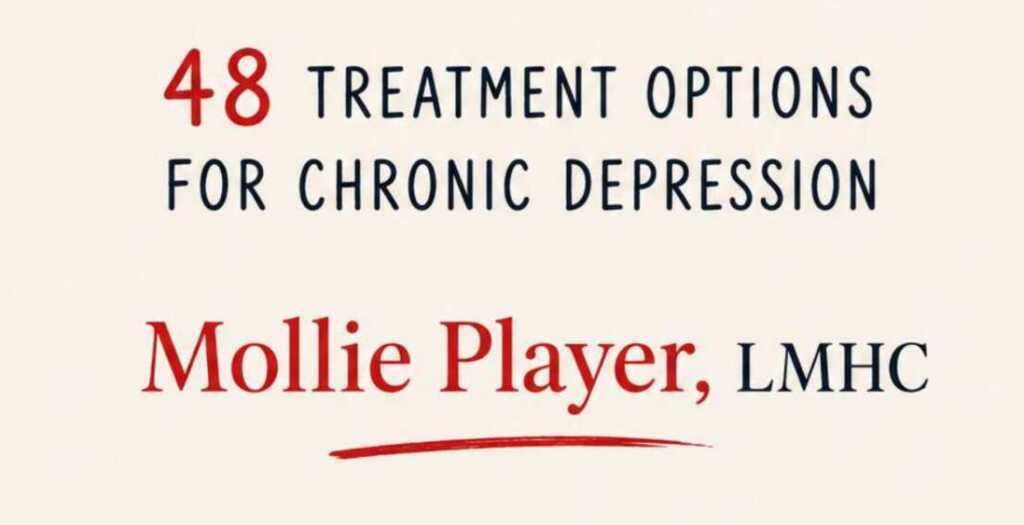
That’s why I wrote We Get Better: 48 Treatment Options for Chronic Depression. Not just because I’m a therapist specializing in thought-based disorders like depression, anxiety and OCD. But because people with mental health needs, as well as the people who work with them need more than one-off pieces of advice: they need a systematic, comprehensive treatment strategy. More than that, though, they need a gentle but persistent reminder that there is always hope.
They need to know that we get better.
Mollie Player is a licensed mental health counselor, a self-help writer and a passionate advocate for practical, solution-focused depression treatment. Her goal is to help people perform feats of great strength—feats like achieving personal goals, managing mental health challenges … maybe even finding inner peace.
You can get her book, We Get Better: 48 Treatment Options for Chronic Depression, on Amazon.
Prospective Washington-based clients can contact her at mollie@